What equipment for goldwork embroidery?

When you're starting out in goldwork embroidery, choosing your materials can quickly become confusing. Needle, hoop, jaseron, smooth purl, coiled purl, or padding – you never know where to begin. Here are a few simple supplies to start goldwork embroidery that we probably all already have at home!

Summary

The embroidery hoop
What are the differences between French purls?
How to embroider rococo?
Wax in goldwork embroidery
The right needles for goldwork embroidery
Scissors in goldwork embroidery

The embroidery hoop

This is generally the first tool you use when you start embroidering. For a first project or an introduction, an embroidery hoop is ideal. It's easy to handle, perfect for small patterns, and more than enough to get started.

There are many different types of hoops. Prioritize wooden hoops, not plastic. When embroidering, remember to re-tighten your fabric between each embroidery sessionto maintain good tension.

What are the differences between bullion stitches?

Impossible de parler de matériel de broderie d’or sans évoquer les fils métalliques. Ce sont eux qui donnent toute la richesse et la brillance à l’ouvrage !

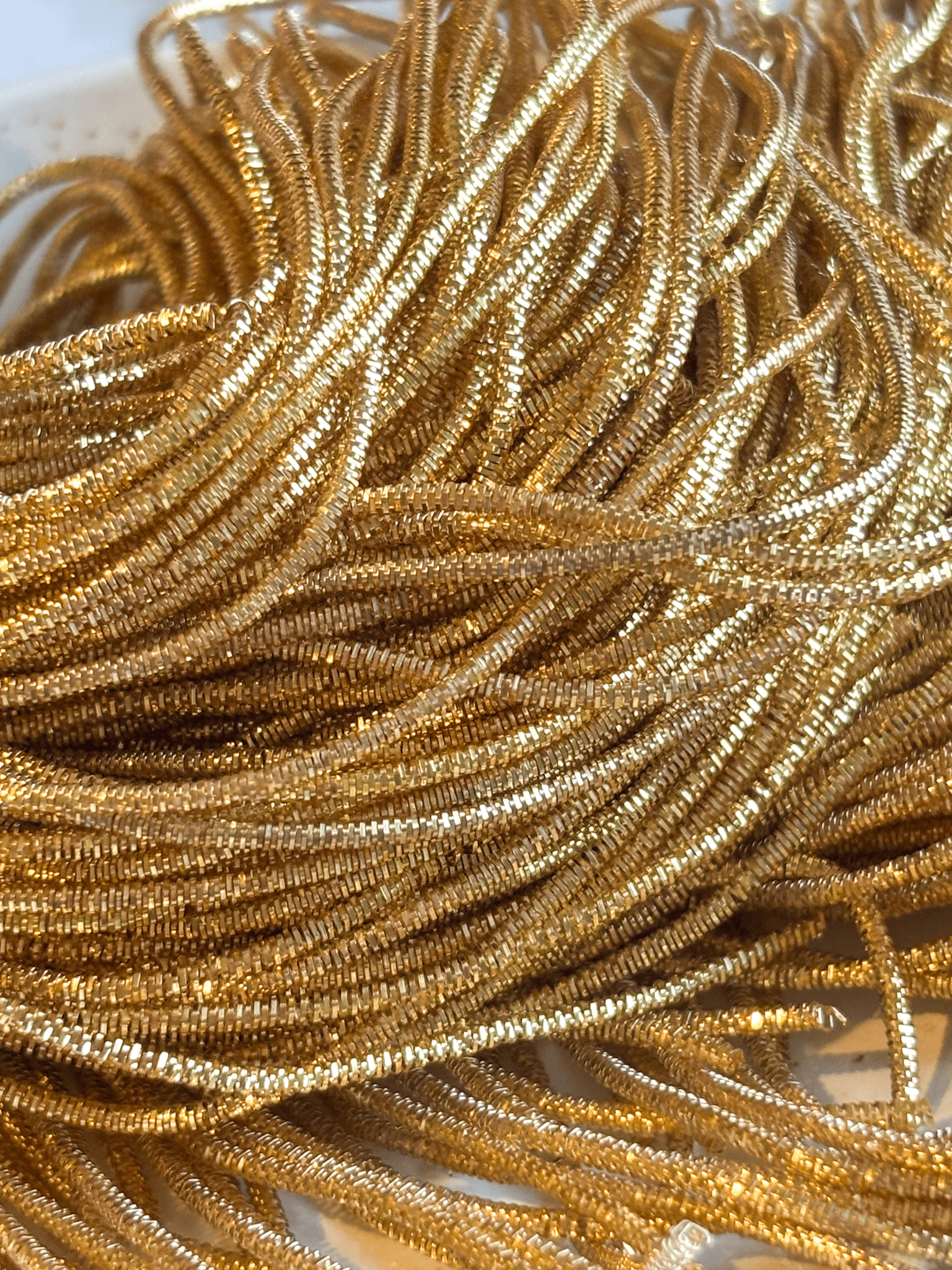
La cannetille est l’un des fils métalliques les plus emblématiques en broderie d’or. Elle se présente sous forme d’un petit ressort creux que l’on découpe en segments avant de la poser à l’aiguille.

On l’utilise en broderie or pour : créer du relief, remplir des surfaces et apporter de la texture et de la lumière.

Il existe plusieurs types de cannetille en broderie or :

  • la cannetille lisse : régulière et brillante, parfaite pour des remplissages nets et élégants
  • la cannetille perlée : composée de petites facettes, elle capte davantage la lumière et apporte un effet précieux
  • la cannetille frisée : plus texturée et irrégulière, idéale pour donner du volume et un aspect plus vivant au motif de broderie

Quand on débute, pas besoin d’en stocker des mètres de fils métallique. Quelques mètres de cannetille lisse ou cannetille frisée suffisent largement pour se faire la main, comprendre comment la découper et broder la cannetille. Le plus important reste surtout de travailler avec une cannetille bien régulière, qui se coupe proprement et se pose sans s’écraser.

How to embroider with soutache

Le jaseron est un grand classique en broderie or. C'est aussi un ressort, comme la cannetille, mais plus épais et structuré.

On l’utilise surtout en broderie d’or pour : tracer des contours nets, structurer des modèles de broderie graphiques et apporter une touche lumineuse et précise dans l'ouvrage.

Contrairement à la cannetille lisse ou frisée, le jaseron ne se découpe pas en petits segments pour du remplissage. Il se pose en ligne continue et se maintient avec un point de broderie simple : le point de couchure (ou point de Boulogne).

Quand on débute, le plus délicat n’est pas toujours le geste, mais d’avoir le bon matériel de broderie or sous la main : jaseron, fil de couchure, support et aiguilles compatibles. C’est pour cela que beaucoup commencent avec un kit de broderie d’or débutant où tout est déjà réuni !

Using wax in goldwork embroidery

When you start goldwork embroidery, you wouldn't think for a second that wax could play a role in embroidery. And yet it does! Wax in embroidery becomes very practical when you want to embroider smooth and coiled purl, for example.

When you wax your couching thread (cotton or polyester thread), you strengthen the threadand prevent knots during embroidery. In pieces where coiled purl is embroidered in small sections, for example, wax helps to make the process smoother. This makes the work much more enjoyable!

The Best Needles for Goldwork Embroidery

In goldwork embroidery, the needle really makes a difference! To embroider with purl, you usually use a special purl needle No. 10: short, fine, and with a very narrow eye, ideal for passing through the fabric without damaging the metallic elements.

For thicker gold threads, especially in couching, a chenille needle No. 20is more suitable. Its large, strong eye guides the thread without weakening it.

To start goldwork embroidery, these two needles are more than enough to work comfortably.

Which scissors for goldwork embroidery?

This is perhaps where everything comes into play. In goldwork embroidery, embroidery scissorssuffer from cutting threads. Metallic threadsquickly wear down the blades, so ideally, you should have a pair reserved solely for this use.

The sharper the scissors, the cleaner the cut of jaseron, purle, and thick threads, and the more precise your work becomes!

Opt for bent scissors. They are very practical for cutting threads as close as possible. If you don't have bent scissors, a good pair of straight scissors will suffice.

Workshop tip: have two pairs and clearly mark the pair dedicated to goldwork embroidery to avoid any confusion.

In summary, beginner goldwork embroidery supplies can remain simple and accessible. There's no need to accumulate too many supplies at first: a good hoop, a few purls, some jaseron, suitable needles, and sharp scissors are enough to get started under good conditions. By choosing quality goldwork embroidery supplies adapted to the basics, you'll be able to progress more confidently and quickly gain precision!

Get started with

Embroidery kits

Afficher tout